The Responsibility of Resurrection: Spring’s Invitation to Begin Again

Part of The Seasonal Psychologist series, where I explore the psychological wisdom embedded in nature’s cycles, offering both therapeutic insight and practical guidance for aligning your inner work with the earth’s ancient rhythms.

Yesterday marked the Spring Equinox, and here in Michigan, the earth offers us her most honest teaching: resurrection is messy work. The snow that blanketed our gardens just days ago now reveals patches of brown earth, and something green pushes through despite the cold. Not the orderly emergence we might hope for, but the chaotic, determined sprouting that characterizes real transformation.

What’s up?

As a Pagan psychologist, I find myself drawn to the word “resurrection” rather than the gentler “renewal” or “rebirth.” Resurrection implies that something actually died… that we’re not just getting a fresh coat of paint, but emerging as something fundamentally changed. It can feel that way in Michigan for sure, like we’ve spent too long in a dark underground bunker and are climbing out now, blinking at the bright sun and praying it lasts. This week, as my clients and I witness the first brave plants attempting their return to life, we explore what it means to carry the responsibility that comes with being brought back to life.
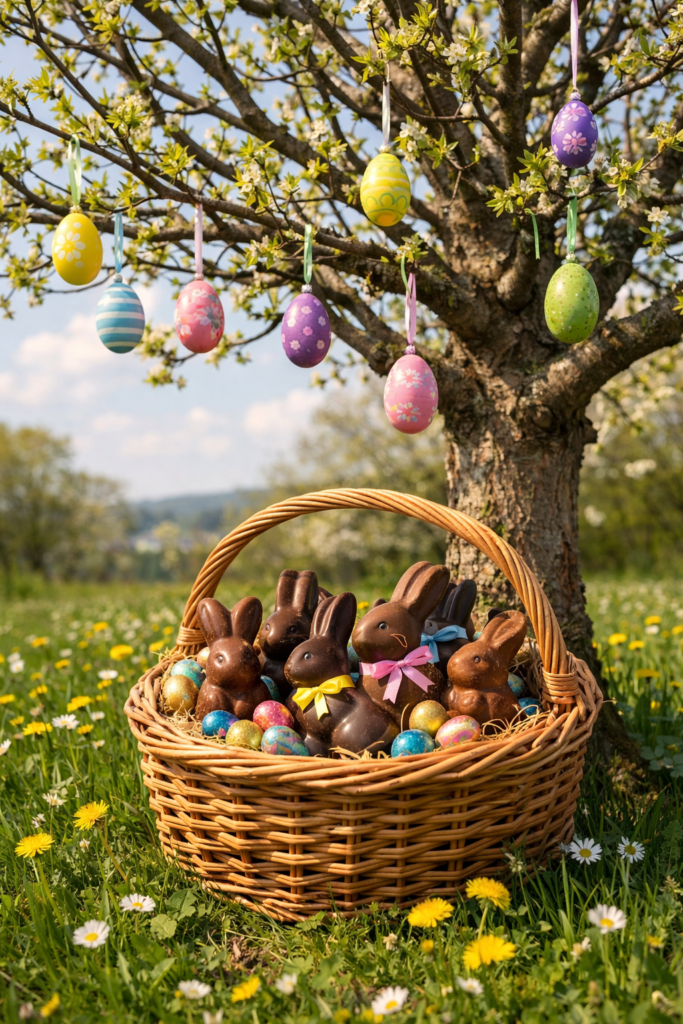
A spring tree is home to easter eggs hanging from the branches. An Easter basket full of chocolate bunnies sits at the base.

This is my favorite time of the year, and my favorite seasonal Sabbat. Everywhere around us, the sacred and secular dance together in delightful confusion. Eggs hang from trees in suburban yards, fertility symbols suspended from branches that Pagans have long considered sacred. Chocolate bunnies proliferate in grocery store aisles while churches prepare for resurrection services. Easter and Eostre celebrating the same essential mystery: life’s refusal to stay dead.

The egg itself becomes our perfect teacher here, that sealed vessel holding everything needed for new life, requiring the violence of cracking open to birth what’s been gestating in darkness. Whether we’re contemplating Christ emerging from the tomb or the earth awakening from winter’s sleep, the psychological truth remains the same. Resurrection requires the destruction of the old container. The shell must break. The ground must crack. The frozen heart must thaw… and once that breaking happens, there’s no going back to what we were before.  

If we’ve been using the wheel of the year as our framework, then what’s emerging now connects directly to what was planted at Samhain. Those intentions we buried in autumn’s dark soil, those treatment goals we whispered to October’s dying leaves…whether planted intentionally or scattered haphazardly, we’ll soon get to see what actually took root.

In my office this week, clients peer out the window at the tentative green shoots and name what’s surfacing in their own lives. “I’m actually setting boundaries with my boss.” “I quit that job that was killing me slowly.” “I told my husband I need us to go to couples therapy.” These are the fierce breakings-through that happen when our resplendent life-force refuses to stay buried. But here’s what nobody tells you about psychological sprouting: not everything that emerges is what we thought we were planting.

The Psychology of False Starts
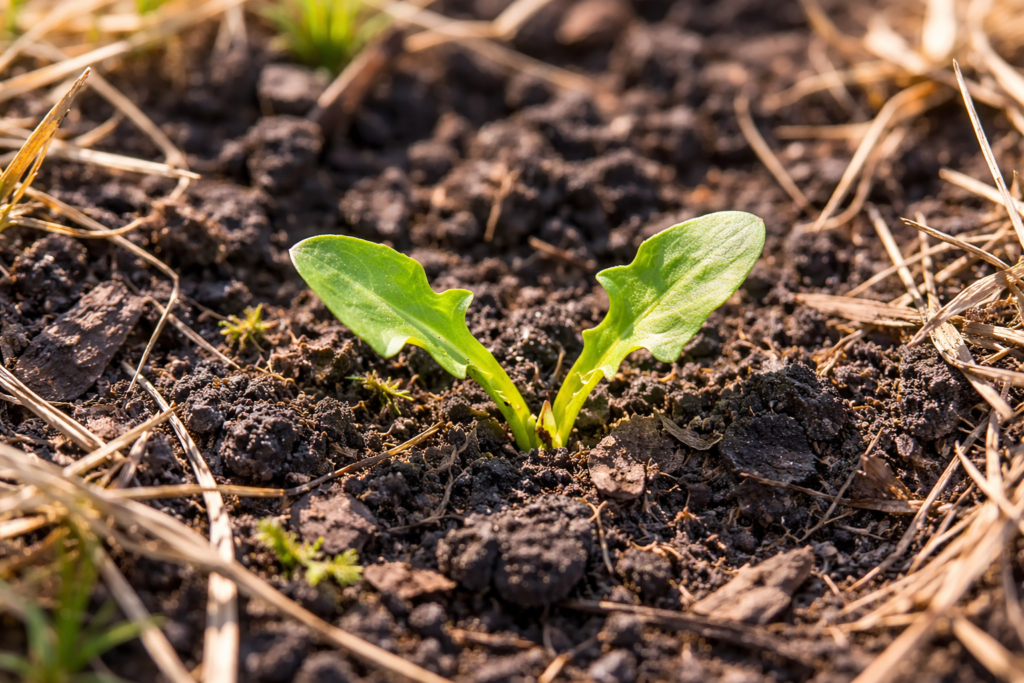
Just this morning, walking to my car, I noticed a tiny green shoot pushing through the snow. Certain it was the sighting of the first crocus (a high holiday in my heart), I bent over to welcome it, only to realize it was a dandelion. A dandelion! Not the carefully planned perennial I’d envisioned, but a wild, unstoppable weed. “Well done little dandelion” I whispered to it, “you grow girl!”

This is the psychology of false starts, and why they’re actually perfect. Sometimes what emerges from our therapeutic work isn’t the neat, organized growth we planned. Sometimes it’s the messy, inappropriate, inconvenient aliveness that refuses to follow our timeline. The client who planned to work on anxiety finds herself grieving a twenty-year-old loss. The one focused on career goals discovers she needs to address childhood trauma first. If I had a pack of wildflower seeds for every time a therapy goal took a radical left turn when we all thought it was heading to the right, I could spread a LOT of beauty.

Nature doesn’t apologize for false starts. She tries everything, lets some things die back, celebrates what thrives. In therapeutic work, we’re learning to do the same. That relationship that didn’t work out? That business venture that failed? That healing modality that left you feeling worse instead of better? All of it was necessary soil preparation for what wants to grow next. If it’s true for the land, it’s true for the us too.

Trusting and waiting

Here in Michigan, we know better than to trust March’s promises. Real spring won’t arrive until May, and even then, we’ll keep the winter coats handy. If there’s one thing you can hang your hat on – as my grandma used to say – it’s that the crocuses (croci?) will be snowed upon at least once, and their plucky little selves will live right through it. But therapeutic patience asks something different of us than meteorological caution. It asks us to honor the early signs while staying grounded in seasonal reality.

This week, I’m working with clients who are afraid to celebrate their progress. “What if this good feeling doesn’t last?” “What if I’m just fooling myself?” These are the questions of people who’ve learned not to trust the early signs of their own resurrection.
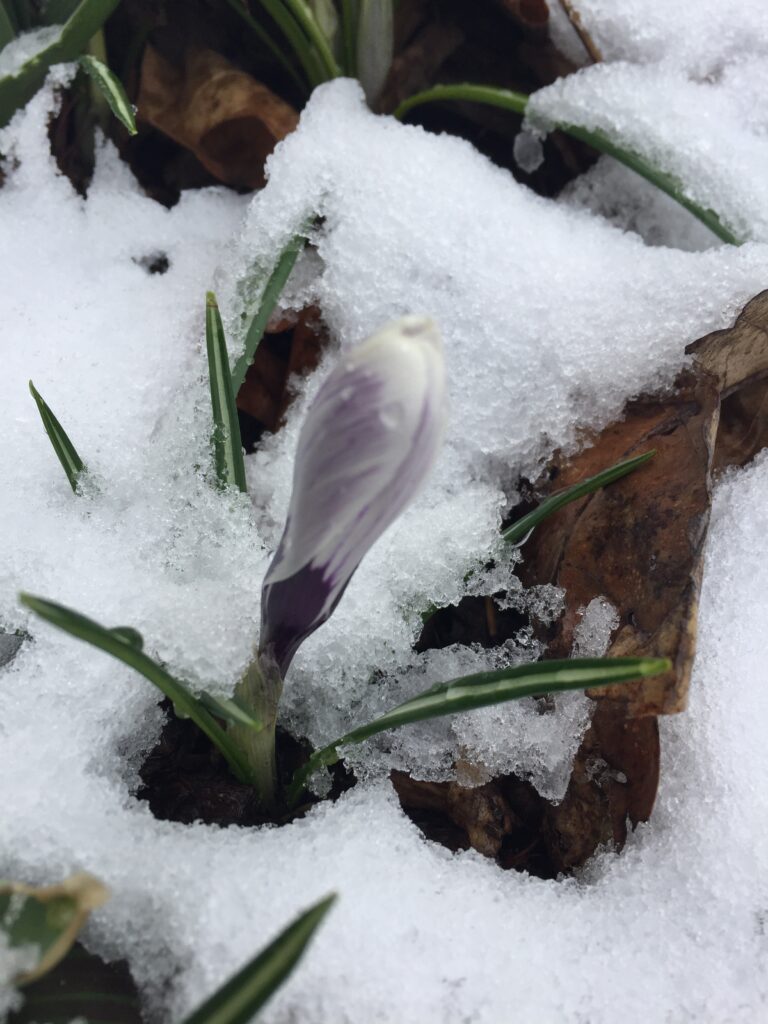
I send them out to the yard, to spy on those plucky brave crocuses. They push through snow, knowing full well that more cold is coming.

They don’t wait for guaranteed safety. They respond to light, to the subtle shift in day length that promises longer days ahead. They trust the process while staying realistic about conditions.

Therapeutically, this means celebrating the green shoots of healing while honoring the frozen ground that still exists. It means noting progress without demanding permanence. It means trusting your instincts about growth while staying connected to professional support.

The Responsibility of Resurrection

When we emerge from winter’s therapeutic darkness, we bring responsibility with us. Not guilt, not obligation, but sacred response-ability. What do we owe to the version of ourselves who survived December’s depression? Who endured January’s anxiety? Who used February’s fierce cold to burn away everything that wasn’t essential?

We owe it to ourselves to take up space. To say yes to invitations. To plant actual seeds in actual gardens. To wear colors again, walk outside again, appreciate the land again. Most importantly we out it to ourselves to believe that our healing serves not just ourselves but ripples out and fertilizes the collective healing our world so desperately needs. If it’s true for us, it’s true for the land too.

This week, as equal light and equal darkness pause in perfect balance before tipping toward summer’s abundance, I invite you to consider your own resurrection story. What died in you this winter? What’s emerging that surprises you? What false starts taught you essential truths? And most importantly, what do you owe to the fierce, resilient, resurrected version of yourself who’s reading these words right now?

As the days lengthen and the land comes back to life, I wish you a joyful resurrection of choice.      

Posted in Uncategorized | Comments Off on The Responsibility of Resurrection: Spring’s Invitation to Begin Again

Got Milk? Celebrating Imbolc in the Deep Freeze.

Part of the ongoing Seasonal Psychologist series, where I explore the psychological wisdom embedded in nature’s cycles, offering both therapeutic insight and practical guidance for aligning inner work with the earth’s ancient rhythms.

Imbolc is upon us, the halfway point between Winter Solstice and Spring Equinox. I like to remind myself and all who will listen that it’s all downhill to Spring proper now. Yet here in Michigan, the earth remains frozen solid. The dangerous cold of these past two weeks has kept us all indoors, huddled against wind chills that could kill, watching from windows as our world transforms into something crystalline and fierce. Imbolc promises that beneath this brutal beauty, life stirs. The quickening has begun.

A ewe nurses one of two lambs in a green field; the other looks at the camera with curiosity.

Imbolc means “in the belly,” “first milk,” and “cleansing,” all references to the first signs of life after winter’s long sleep. As a Pagan psychologist, I find myself drawn to that middle meaning: first milk. In kinder climates, nursing lambs are receiving exactly what they need to grow from their wise and wooly mothers.

Animals do not give birth in conditions unsuitable for newborns, which means that milk is flowing, sustenance is being offered and life is being fed (even in the midst of seemingly impossible conditions). Though it’s more of a metaphor here in Michigan, where our animal babies tend to be born closer to the Spring Equinox than to Imbolc, it still speaks to the wise communion of body and light and land.

In the days ahead, my clients and I will contemplate what sustains us through these final weeks before spring, answering the question that Imbolc has always posed: Where is your metaphoric milk supply? What nourishes you when all other sustenance lies still under frozen ground? And what actualizing is it nurturing you towards?

The Wisdom of Dangerous Weather

If we imagine the year as a pie sliced into eight equal pieces, then each slice represents about six weeks. Six weeks doesn’t sound like a long time, but where Mother Earth is concerned a lot can happen in six weeks (especially in Michigan). The period between Imbolc and Spring Equinox is always a time of wild weather, as Jack Frost and the Green Man battle for the land, swinging us all between frigid wind chills and warm breezes, with flood-causing rains and tree-bending snow often in the same week.This meteorological chaos makes perfect sense when you understand what’s really happening.

Yule greenery burning in an outdoor winter fire, guarded by a small straw Brigid's Wheel which leans against the fire ring.

The last weeks of any pregnancy are uncomfortable and unpredictable on all counts save one: new life will be born. Our Mother Earth is in her final trimester now, and whether we are patient or not, spring will come. Once it does, the flurry of new growth is always disorientingly spectacular.

Sacred Study and New Beginnings

Traditionally, Imbolc is considered auspicious for undergoing ceremonial initiation or dedicating oneself to a new path of study. There’s something about this betwixt and between time, neither winter nor spring, that calls us toward commitment. Perhaps it’s because we can finally sense spring’s approach, even if we can’t see it yet. Perhaps it’s because the returning light reminds us that growth is inevitable, a slow cart ascending the roller coaster apex now, but soon a speeding force of nature carrying us through the remaining year faster than we ever think it will.

As you consider the months ahead, what are you called to explore? In my practice this week, clients commit to daily meditation rituals, crafting apprenticeships, embodied movement practices and to finally reading those books about healing that have been sitting on their nightstands since November. What wants to be studied more deeply?

Final Resting, Final Preparing

 These last six weeks before spring can be viewed as the final resting days and the final preparing days before the flurry of spring begins. How are you resting, and in preparation for what?  

In the slowly lengthening days ahead, as dangerous cold gives way to the promise of lengthening days, I invite you to celebrate what has survived Your body, which has carried you through the darkest months… Your spirit, which has found sustenance even when the ground seemed barren… Your capacity to believe in spring when all evidence suggests perpetual winter. (Add in your skin, and houseplants too, both straining toward the light and too dried out from the humidity leeching cold, but resolute and resting). Rest in preparation for the returning light and all it activates; all it will reveal.

For what is resting in preparation but faith? Faith that all is well-organized and perfectly imbued with wisdom as old as the stars.  Those nursing lambs in more temperate climates can teach us a bit about faith: their milk comes exactly when it’s needed, even in conditions that seem impossible. Ewes care for their lambs and Mother Earth cares for us, dancing us closer to the Sun a couple of minutes each day, proof-perfect that this entire wild ride is nothing but a big old miracle of precise yet wild unfolding.

Moving through these final winter weeks, trust that you too are being fed by sources you cannot see, sustained by a love that flows regardless of external conditions.

Getting ready to get ready

Psychologically, any change process happens in stages, and Imbolc represents the pre-readiness stage. We’re going to be busy when spring arrives, preparing the garden and learning the lessons we have committed ourselves to. So for now, we access our wise mind, thoughts and feelings in harmony, and we plan; plan for the equinoxical tipping into Spring proper.

A boy and a dog look outside a window, to a barren cold field. Above their heads is a shared imagination bubble showing them playing fetch together.

Speaking of spring, in Michigan we will soon spring forward into daylight savings time, a change that both exhausts and exhilarates us as the wild weather settles into spring’s steady unfolding.  But today, we honor what sustains us in the deep freeze. Today, we prepare for the spectacular flurry of new growth that’s coming, whether we’re ready or not.

What is the milk feeding your dreams right now? The earth knows. The lambs know. And somewhere, deep in the warmth of your winter belly, you know too.

Next time, we’ll explore how to recognize when winter’s grip is truly beginning to loosen, and how to prepare for the psychological intensity of spring’s arrival.

Posted in Uncategorized | Comments Off on Got Milk? Celebrating Imbolc in the Deep Freeze.

Between the Return and the Quickening

Betz King is The Seasonal Psychologist. She shares an ongoing series exploring the psychological wisdom embedded in nature’s cycles, offering both therapeutic insight and practical guidance for aligning  personal growth with the earth’s ancient rhythms.

The candles of Solstice have burned down to nubs, and yet spring’s first flowers remain buried beneath frozen soil. We find ourselves in what I call the “gestational darkness” of the year, that peculiar and ever-so-long stretch between December’s return of light and February’s first subtle quickening. This week, as Michigan swings between unseasonable thaw and bitter freeze, let’s explore what it means to live in this particular betwixt and between.

Most of us rush from holiday to holiday, Sabbat to Sabbat, as if the sacred only dwells in marked celebrations. But here’s what the Maple tree outside my office window knows: the real work happens between the festivals. Right now, while we humans fret about credit card bills and failed resolutions, that Maple is pulling energy deep into its roots, converting starlight and snow into the fuel for April’s leaves. The tree doesn’t wait for Imbolc to begin its preparation. Neither should we.

The Psychology of
Sacred Preparation

As a Pagan psychologist, I’ve noticed that those who struggle most with change are those who expect transformation to arrive suddenly, like a package from Amazon. But watch how nature actually works… The crocuses that will poke their heads up in a few months? Their bulbs have been gathering strength since November. The lambs that will nurse at their mothers’ teats? They’ve been growing in darkness since autumn’s mating.

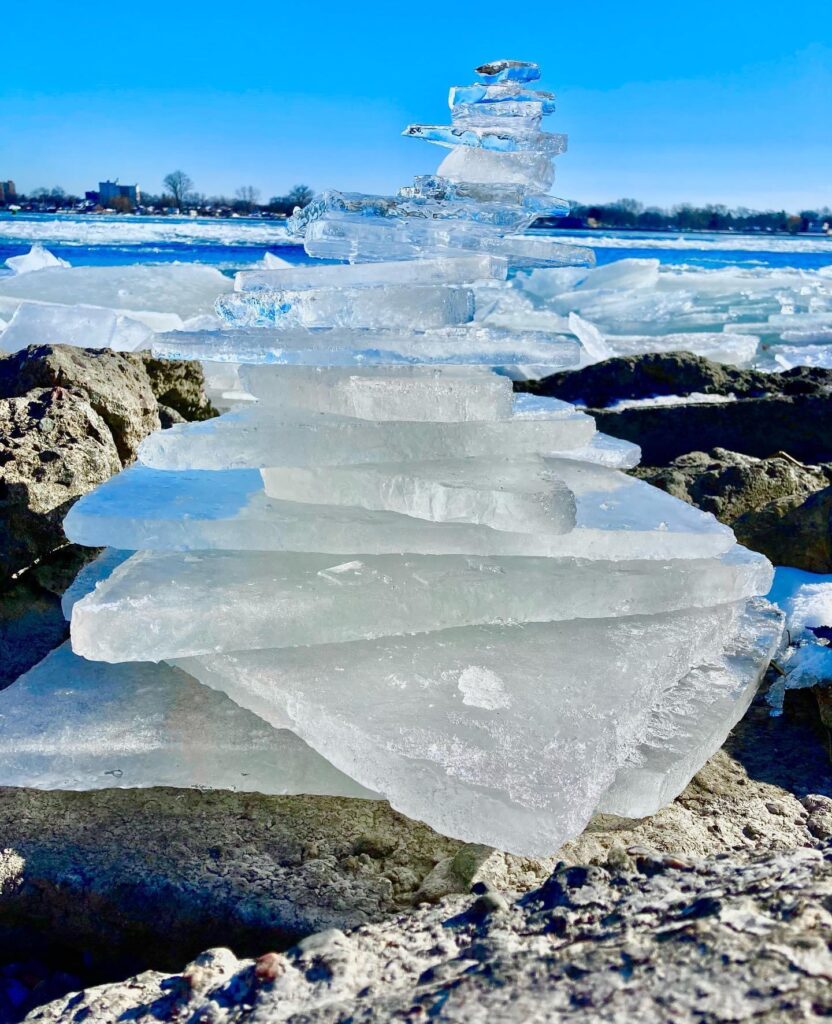
On a beach, triangular pieces of ice are stacked atop each other, largest on bottom, smallest on top, wtih a sunny and ice filled Lake Michigan in the background.

These six weeks between Winter Solstice and Imbolc are a time of quickening when life becomes actively self-directed again after dormancy. Not visible yet, not safe yet, but no longer inert. This is the time when life stirs and stretches in its sleep, still hidden from view, still needing protection, but awake now…  aware… beginning to remember what it means to grow. Here in Michigan’s deep winter, quickening isn’t about visible change. It’s about sap starting its slow journey upward, about seeds beginning to soften their shells.

Psychologically, this is the time when we mistake stillness for stagnation. Nothing seems to be happening. The treatment goals we set at Samhain feel distant. The seeds of change we planted haven’t sprouted. We feel frozen and stuck, suspended between what was and what might be. Good 🙂 This is exactly where we need to be.

Each year at this time, I invite my clients to resist the cultural pressure to “hit the ground running” in January. Instead, I ask them: What if these weeks were your bulb time? What if the absence of visible growth is the presence of deep preparation?

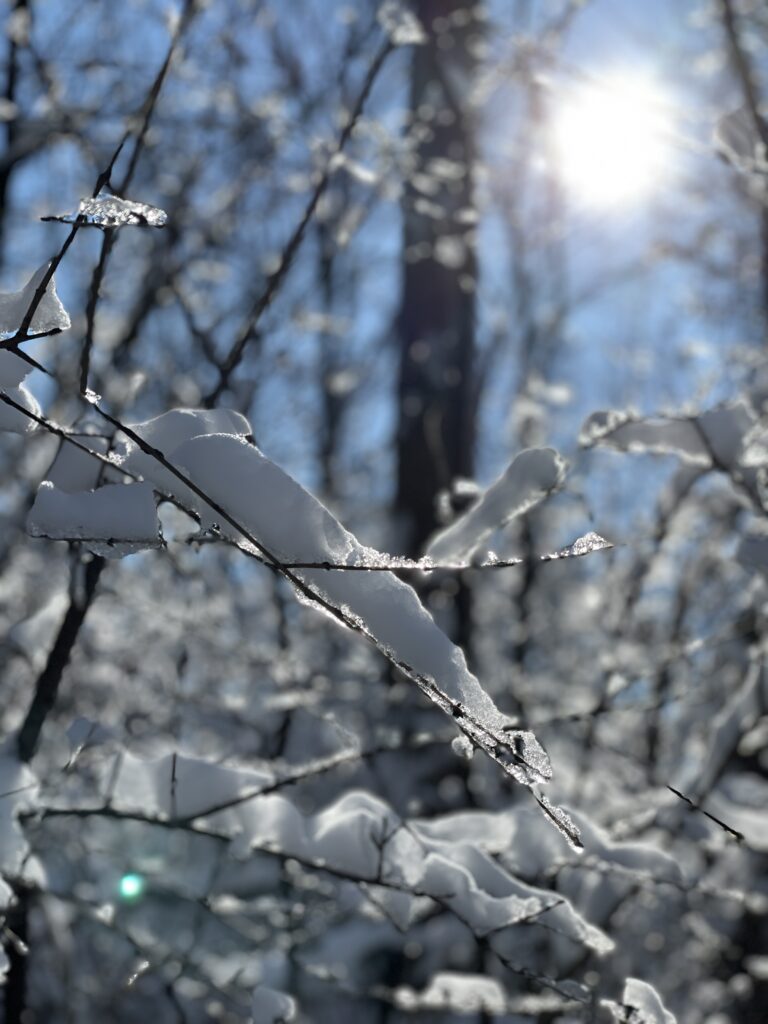
A close up of thick snow blanketing small tree branches, with a background of blurry sunshine and tall trees.

Practical Magic for the In-Between

The word “prepare” comes from the Latin “praeparare,” meaning to make ready beforehand. Notice that “before” part. Preparation isn’t the celebration; it’s what makes the celebration possible. If we know how to read nature’s syllabus, these weeks between Solstice and Imbolc offer us a masterclass in sacred preparation,

Here’s what I’m practicing, and what I invite you to consider:

Track the Light: Yes, the sun returned at Solstice, but can you actually notice it yet? This week, commit to witnessing sunset. Not photographing it, not posting about it, just witnessing it. Notice how incrementally, almost imperceptibly, it shifts. This is how real change happens: slowly, then suddenly.

Feed What’s Dormant: Just because you can’t see growth doesn’t mean nothing needs tending. The earth beneath the snow still teams with life, waiting. My seed catelogs have arrived, allowing me to imagine the summer flower boxes at Summer Solstice.
What dormant dreams of yours need feeding right now? Not forcing into premature bloom, just feeding. For me, it’s a writing project that’s been wintering for longer than winter. But this week, I’m not writing new material; I’m reading what I’ve written with curious compassion, adding notes in the margins, leaving breadcrumbs for future me.

Create Space for Quickening: Imbolc means “in the belly,” referring to the pregnant ewes who carry spring’s promise. But pregnancy requires space, literal and metaphorical. This week, clear something out. Not in a New Year’s resolution frenzy, but with ritual intention. I’m clearing my altar, lovingly tucking my Ancestors back into their resting places and allowing the surface to sit empty for a time while I contemplate the Imbolc alter for a bit. What needs clearing in your life to make room for the coming quickening?

The Sacred Ordinary of January’s Dark

Yesterday while walking the dogs, I saw three deer standing at the edge of the woods. They weren’t moving toward anything or away from anything. They were simply standing, breathing steam into the cold air, being fully present to the twilight that comes so early at this time of year. No anticipation of spring, no longing for autumn’s abundance, just presence to what is. We stood for a bit with them, the dogs scenting more than I’ll ever know, in deep reverence and gratitude.

This is what the weeks ahead ask of us: presence without production. In our capitalism-soaked culture, this feels almost heretical. My clients often say things like, “I should be further along by now,” or “Nothing’s happening in therapy.” I remind them that at this very moment, beneath Michigan’s frozen ground, millions of seeds are transforming themselves completely, breaking down their protective shells, reorganizing their very structure to become something entirely new. And it’s happening in sacred darkness, stillness and slowness. Why, I ask them, should we think ourselves any different? There are wondrous things occurring just below our surfaces too.

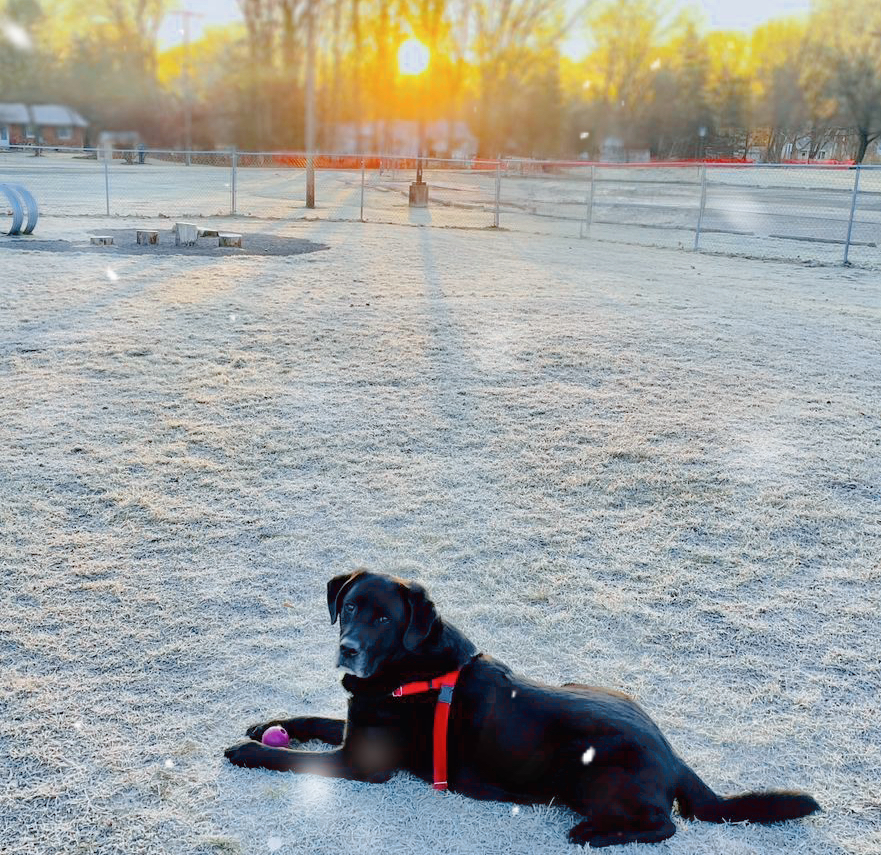
A black labrador with a white muzzle and a red harness lays in a field of snow. He has an orange ball between his front paws, and the winter sun is setting behind him.

The Ancestral Wisdom of Winter’s Middle

Our ancestors knew something we’ve forgotten: the middle of winter was not a time for beginning but for deepening. They didn’t make resolutions; they told stories. They didn’t start new projects; they mended what was broken. They didn’t seek transformation; they sought sustenance.

What if we approached these weeks the same way? What if instead of trying to become new people, we became more deeply ourselves? What if instead of adding more to our lives, we repaired what’s already there?

This week, I’m working with a client who keeps saying she’s “stuck.” But when we explored what “stuck” meant, she realized she was actually gestating. The inertia she thought was holding her back was actually holding her deep, keeping her still enough to hear what her bones have been trying to tell her for years. Contrary to cultural programming, stillness is not synonymous with broken. Sometimes what looks like stuckness is actually a sacred pause.

Your Invitation for These Threshold Weeks

As your own journey carries you through these dark weeks before Imbolc, I invite you to consider: What wants to gestate in your darkness? Not what should grow, not what needs to change, but what wants to quicken in its own time?

Look out your window right now. Whatever you see, that’s your teacher for these weeks. Bare branches? They’re teaching you about essential structure. Snow-covered ground? It’s showing you how to hold and insulate what’s not yet ready to emerge. Gray skies? They’re reminding you that not every day needs to be bright to be sacred.

The Seasonal Psychologist in me knows this: Imbolc will arrive as usual, smack-dab in the middle of Winter and Spring. But whether we’re prepared, whether we’ve used these dark weeks to gather our strength and clarify our purpose, that’s up to us. The crocuses know when to bloom because they spent these very weeks converting cold soil into future flowers. They don’t rush orworry. They simply do the deep, dark work of becoming.

Next week, as you navigate the ordinary extraordinariness of January, remember that you too are part of nature’s wisdom. Your restlessness, your impatience, your longing for spring? These are just the labor pains of transformation. The fact that you can’t see your growth doesn’t mean it’s not happening. It just means you’re doing it right, down in the dark where all the best magic happens.

So here’s my invitation: Stop trying to bloom in January. Instead, be like the Maple outside my window. Pull your energy deep. Convert this darkness into fuel. Trust that when Imbolc arrives with her milk and her flames, you’ll be ready not because you forced yourself to grow, but because you honored the sacred preparation that these threshold weeks offer.

What seeds are you gestating in your own darkness? What wants to quicken in your belly? The trees know. The sleeping seeds know. And somewhere, deep in your bones, you know too.

Soon, we’ll explore how to recognize the first subtle signs of Imbolc’s approach, even when the ground remains frozen. Until then, may your darkness be generative and your stillness be sacred.

Posted in Uncategorized | Comments Off on Between the Return and the Quickening

On Mabon 2025

“I notice that Autumn is more the season of the soul than of nature.”

Friedrich Nietzsche

I conceptualize both my personal development, and that of my clients, within the framework of our local 4-season landscape.  Mostly this means a framework of trees, crops native to Michigan, and lots of plants and flowers.  The Pagan path is a seasonal one, hosting 8 holidays called Sabbats.  They parallel the movement of the sun across a year.  Each holiday expresses a facet of the relationship between Light, Dark and life.  I use them as lenses of reflection, opportunities to contemplate the cycle of birth, growth, harvest and death that impacts all living beings.

As a Pagan psychologist, many of my clients have some form of an earth-based belief system.  This allows us to revisit treatment goals “quarterly” at Fall Equinox, Winter Solstice, Spring Equinox and Summer Solstice.  The view from my office window is lush with trees.  A simple glance outside provides the framework for our review; whatever the trees are doing becomes an invitation to consider the same within ourselves.

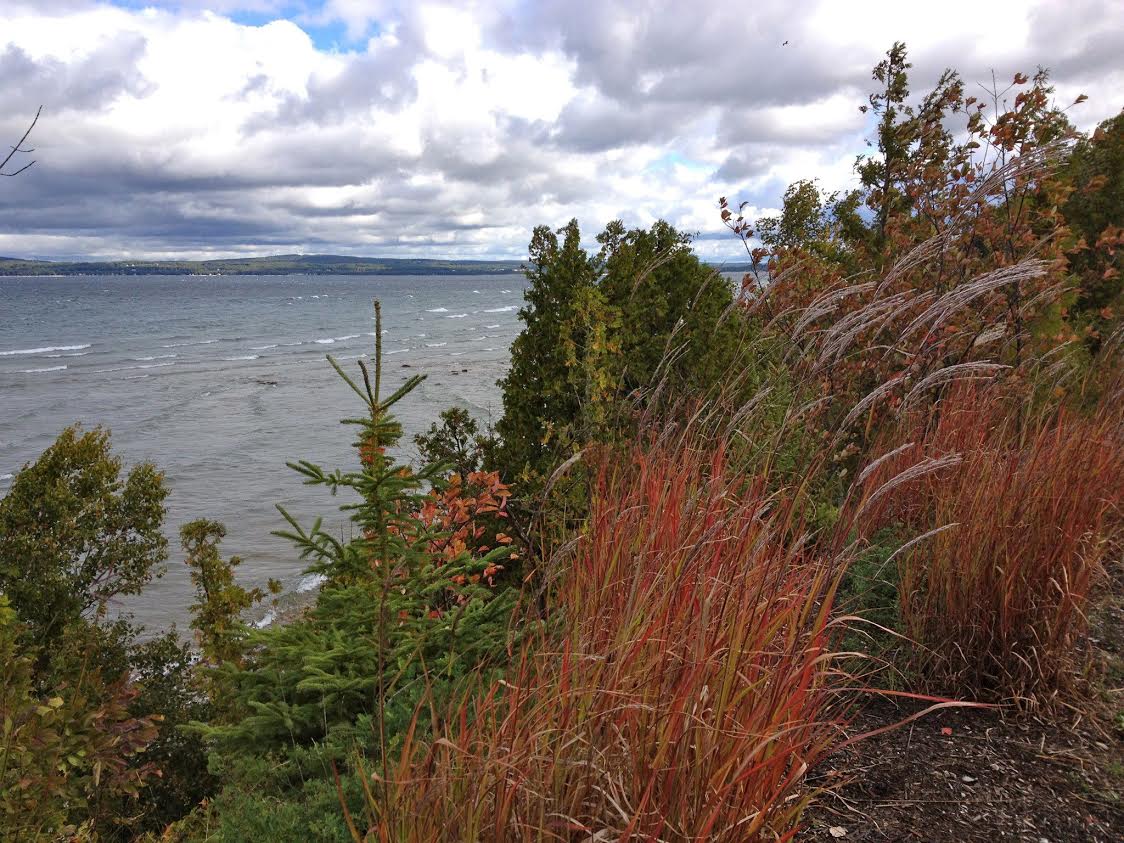
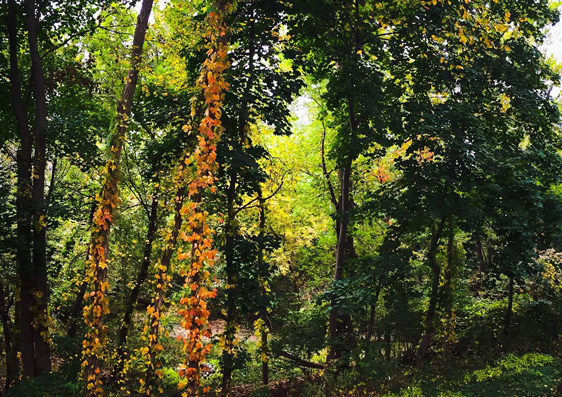
Trees in fall colors with lake in background.

This year, the Autumnal Equinox – also called Mabon –  falls on Monday September 22 (while in the Southern Hemisphere, it is the Spring Equinox).  The hours of light and darkness are equal for just a moment; then darkness prevails until the Winter Solstice brings the Sun’s return.

Psychologically, this is a time to contemplate the idea of balance, endings, and goal setting for the spring.  I am always touched to behold the beauty of the trees at this time, so gorgeous as their leaves begin to fall and they prepare for Winter’s hibernation.  I remind myself and my clients that we too are spectacular, and need not fear the coming darkness.  We simply need to prepare, and mindfully plant our seeds for the spring.

This week, my clients and I will talk about what they’ve harvested – or achieved –  from their treatment plan goals.  We will take stock of the supplies – or skills – they have stored up for the coming darkness.  This darkness might be actual, as we move into the last quarter of the year, or it might be interpersonal darkness, as we face hardship, loss or growing pains.  We will also consider the balance of light and dark within; the light that drives us to self-actualize and the darkness of our unexpressed shadow parts.  Lastly, we will bring our awareness to the seeds that are falling into the ground, we will name them as goals, and speak our intention to manifest them in the spring.

In this way, we are both contemplating our progress thus far, and planning forward for more growth, which is in alignment with a traditional quarterly review of treatment goals.  It’s also just a good idea to keep an eye on personal growth in some kind of orderly and consistent fashion.  Trees make it very easy.

Many of our fall rituals have at their base the intention to prepare us for the coming darkness.  Reluctant to move indoors just yet, we happily pull out hoodies, visit cider mills, take hay rides and stay close to bonfires.  The Pagan year comes to a close with Samhain on October 31, and soon we will see Halloween decorations.  They too prepare us for the coming darkness, communion with ancestors, and contemplation of our own shadows.

As you experience the glory of autumn, I invite you consider the ways that you are like a strong tall tree….. grounded in the earth, reaching toward the sky, gracefully releasing all that no longer serves you.  Name what you are releasing, let it fall from you as gracefully as the leaves are falling.  Then turn your awareness to the coming spring, and take a few moments to name the seeds that are falling.  Lastly, I invite you to surrender to the darkness without fear, and to use the coming months as a time for contemplation, reflection and rest.  The Sun’s return is guaranteed at Winter Solstice.  Until then, may you – like the gorgeous trees that surround us on the Fall Equinox – stand in rooted faith, take deep rest, and surrender to the ever present cycle of the seasons.

Betz King is a fully licensed psychologist, Priestess of the Western Mystery Tradition, Reiki master and enthusiastic tree-hugger. She practices seasonal psychology as a full-professor at Saybrook University, while overseeing the existential-humanistic offerings of King & Associates Psychotherapy, and sharing her heart and home with her husband and their tree dogs, Willow, Rowan and Bodhi.

Posted in Uncategorized | Comments Off on On Mabon 2025

Honoring Sid

Dear Sid,

You are off to the Summerland, and I find myself using all the things I’ve learned from you to grieve the loss.

I check in with my body to locate the grief. It is in my heart, and not as heavy as I imagined because the torch that you lit from your own is there as well.

I ask my three-day headache what it has to say, and it answers, “big shoes to fill and my feet are so sad.”

I note my ever-present self-talk, how easily the either/or creeps in, and I bring the word ‘and’ to the table. This word ‘and’ – I got it from you, so so long ago. It is the foundation of my love for venn-diagrams as the perfect teaching tool, something I’m now known for but really belongs to you.

As I create my fall syllabi and courses, I’m making room for the first person “I” in papers because (everyone say it aloud with me here….) ‘the academic IS personal’.

A client brings a dream, and I invite her to ‘be’ the various parts, to give voice to the grandfather clock, the rubber boots, the crying blue-jay.

I re-configure the two-chair method for the virtual screen and repeat “you’re being awfully hard on yourself” when I see the top-dog trying to bully the underdog.

This last week, just to feel close to you, I used one of my favorite teachings of yours with every single client – the one where you taught us that the end of any sentence a client speaks contains an arrow pointing to where to go next. It still works.

In the first semester of my MA program at The Center for Humanistic Studies, I met you at a ‘special topics’ on gestalt dream work, where I naively shared a dream involving Alice (of Wonderland) and a parade. Sounds innocent enough, but we all know what happened in about 8 minutes flat.

After graduation I had some of the best therapy of my life with you – a boot camp of self-compassion and integration.

After that, we kept in touch and had breakfast one day (Village Grill on Orchard Lk Rd) and you mentioned hoping I would return to CHS for my PsyD. You said “I’m going to retire eventually, and I’d like to know I’m leaving good clinicians behind”. I’m pretty sure I decided to go in that very moment, which granted me….

….four more years of doctoral studies with you!! So many classes!! There was one where you told me you didn’t think I was operating on the most current version of myself, (now there’s a therapy nugget I’ve used with myself and others more than once). When you referred a client to me while I was still a student, I remember absolutely panicking –‘who does he think I am?!?’… It turned out to be a great fit, a great piece of therapy, because it turned out you saw the most current version of me even when I didn’t.

Somewhere in there you and Kay came to my wedding, and you taught my husband how to do the hustle! Just one more way that you live on in the hearts of your students.

My fondest memories will be those where I guest lectured for you… you guest lectured for me… the gradual role reversal as you did less and I did more… the pride and love I felt every single time you came to class and made magic. Did you know that Blackstock and I had a running tab of how long it took for your demonstrations to ‘get real’ with a student? Did you know I kept orange juice for you in my office in case your blood sugar dropped? You were the first person I saw at my 50th birthday surprise, I was so overwhelmed I simply hugged you. Having you in my home was so sweet.

I was going to post something about how the world has lost a bright light, but upon closer inspection I have decided that’s not true. I know how many of your students carry you in their hearts and work, I know how we professors are sharing your wisdom with the next generations.

There is plenty of Sid-light shining. But we all have lost a teacher, mentor and friend, so we’re going to be sad for a little while. Don’t worry, we’ll be sure to locate it in our bodies and ask it what it wants to say. I love you Sid. Thanks for everything.

Dr. Sid Berkowitz – Professor, mentor and friend.

Posted in Uncategorized | Comments Off on Honoring Sid

The Seasonal Psychologist: On Lammas / Lughnasadh

I conceptualize both my personal development, and that of my clients, within the framework of our local 4-season landscape. Mostly this means a framework of trees, crops native to Michigan, and lots of plants and flowers. The Pagan path is a seasonal one, hosting 8 holidays called Sabbats. They parallel the movement of the sun across a year. Each holiday expresses a facet of the relationship between Light, Dark, and life. I use them as lenses of reflection, opportunities to contemplate the cycle of birth, growth, harvest and death that impacts all living beings.

As a Pagan psychologist, many of my clients have some form of an earth based belief system. This allows us to revisit treatment goals seasonally. The view from my office window is lush with trees. A simple glance outside provides the framework for our review; whatever the trees are doing becomes an invitation to consider the same within ourselves.  The Oak Holly, whose strength peaks at Midwinter, begins to retreat with the warming temperatures and we are reminded that one season’s strength is another’s weakness.

There were three men came out of the West

Their fortunes for to try

And these three men made a solemn vow

John Barleycorn must die

They’ve ploughed, they’ve sown, they’ve harrowed him in

Threw clods upon his head

And these three men made a solemn vow

John Barleycorn was dead

Traffic. (1970). John Barleycorn must die. [Album]. United Artists.

Lughnasadh, or Lammas, is the first of two harvest celebrations, usually celebrated on or around August first. In the northern hemisphere, it marks the Sun’s arrival at the halfway point between the Summer Solstice and the Autumn Equinox, and the visible shortening of the days. Crops are bountiful. Some are ready for harvest, others need a bit more time. There is a sense of anticipation, apprehension…will the approaching harvest be bountiful? Will the encroaching darkness be kind?

One of four yearly Fire festivals, Lughnasadh is named for the Irish God Lugh, which means “bright or shining One”. He is associated with the Sun and the fertility of the crops.
Some call this Sabbat Lammas, or ‘first loaf’ to signify ritual harvesting of the first grains, then made into bread and eaten in celebration.

The metaphor of sacrifice is strong with this Sabbat. In some places, the growing grain is personified as the Green Man, or John Barleycorn, whose sacrificial death allows others to live.  This sacrifice is reenacted in many ways, most commonly in the gathering, preparing and partaking of the first harvest. It offers a brief moment of reflective and optimistic strategizing before the frenzy of the second harvest, the BIG harvest, arrives with the Fall Equinox.

Psychologically, Lammas allows us to see the beginning fruits of our labor, and promises that more will follow, so it’s a useful time to assess our readiness for the harvest and approaching cold weather. What will we need in those last few months of the year, and what can we do about it now?

This is a time for walking the land to note needed repairs, to assess and address physical health, to ready the kitchen for the incoming bounty and to ready the spirit for the slow descent into darker days and longer nights.

The “seasonal department” of many stores reminds us that it’s time to buy our canning supplies and freezer bags.  Many will soon return to indoor education, in clothes that may no longer fit. There are shoes to be bought and physicals to be scheduled. Basking in the beauty of summer, we nonetheless hear Autumn marching closer; there is a tension between ‘being’ and ‘doing’.

Psychology has identified 5 stages in any change process: pre-contemplation, contemplation, preparation, change and maintenance. Lughnasadh is the stage of contemplation where we are getting ready to get ready.

This week I will ask my clients how their ‘pre-harvest’ is doing. Again, we will revisit the seeds planted (goals set) last fall and this spring to track their progress or lack of. We will voice gratitude for all that has grown as planned, and see what can be done for the stragglers (goals AND plants). There’s still time for plant food and fertilizer, still quite a bit of sunshine available for infusion (into our bloodstream AND our crops). There is still time to go out and play too.

Perhaps most importantly, I will challenge my clients to name that which must be sacrificed for the greater good. For just as John Barleycorn’s sacrifice brings us bread, we too have pieces and parts that might be just lovely as they now are, but could be even more nourishing if allowed to transform. In the coming darkness, what sacrifices will you be happy that you made now?  What needs to go, so that something else can come?

As you enjoy these last few relaxing weeks of summer, I invite you to take stock of all that you have achieved so far. If Serendipity graced you with unexpected blessings, give thanks. Where there have been hardships, name the lessons learned and honor those who helped.

The sun is setting a minute earlier each day, yet the weather still remains warm. Sit for a spell in the twilight between day and night, between what you hoped for and what occurred. Take inventory; take stock. For while the feast day of the Christian mystic Julian of Norwich falls closer to Beltane, her words remind us that the wheel of the year turns instinctively, both inside and outside, thus assuring that “all shall be well, and all shall be well, and all manner of things shall be well”. Bright Lughnasadh / Lammas to all celebrating!

Posted in Uncategorized | Comments Off on The Seasonal Psychologist: On Lammas / Lughnasadh

King and Associates – Psychotherapy for dog lovers

King and Associates is an outpatient clinic providing psychotherapy for dog lovers. We know that the human-animal bond is healing and helpful, and we believe our dogs can be powerful allies in the therapy process.

Posted in Uncategorized | Tagged , | Comments Off on King and Associates – Psychotherapy for dog lovers

A wobbly bard at Imbolc

I wrote this Imbolc / Groundhog’s Day / Candlemas / St Brigid’s Day story in the early aughts, maybe 2001-ish? It still gives me a chuckle:

                                              A Wobbly Bard at Imbolc
I am a bard. I remind myself of this as I sit and wish for words to come. The topic is Imbolc, and the deadline is soon. I have been feeding the fires of my inspiration with symbolism and correspondences, lore and legends… waiting for the birth of my own synthesis. I have been waiting for quite awhile.
I have named my challenge in this writing assignment; I know where the block is coming from. I am writing about Imbolc, but I am living in a personal Samhain. There is much ending and dying in my life right now: behaviors that no longer serve me, my home, some friendships and some faith… there is much room for darkness and fear. Yet Imbolc is a time of new beginnings and of faith restored.
A seeming polarity attends this block, how to write of faith when feeling fear. Yet I know both the Universe and myself rarely offer only two options. It has been my experience that when feeling trapped in polarity, it is helpful to combine the two poles into a third. Combine the endings and the beginnings into a place of both – which is where I sit today at my computer.
On the wheel of the year Imbolc is a place to be visited not only on February 2nd, but anytime the vibration of hope is needed. Can I take my Samhain self to my Sacred Grove and there bathe in the waters of Imbolc?
I break from the computer and enter my small temple… light some incense and make peace with my grove. Settled into my usual nook, I am overcome with both the deep comfort of the woods, and the deep sorrow of my soul. The woods minister to my wounds. My back up against the huge Oak of the North, I pour out my story… loyalties lost, fear, excitement, insecurities, writers block and embarrassment that my faith is not stronger. I ask for the Grove to lend me its knowing of Imbolc, that I may not only connect with renewal but may write of it as well.
The Grove is still. I am lulled by the wind in the trees, the sun on my face, the grounding of the Oak behind me. A rustle in the Western quarter calls my attention to the small pond there. A beautiful woman steps through the trees. She is sky-clad, the breeze blowing her long hair around her. She holds in her arms a swaddled babe and in her hand she carries a water pitcher. She moves towards the pond and settles herself on a large sun bathed rock. She offers a full ripe breast to the infant, who nurses with sounds of satisfaction. The woman closes her eyes and lifts her face to the sun, a half smile on her lips. She sings in a voice both gentle and strong:
“Come unto me my little Yule child, suckle my breasts full of love… come unto me in springtime so mild, suckle my breasts full of love”
She sings this way until the babe has finished eating, and then she rocks back and forth until the child is asleep. She finds a sun-warmed spot among the roots of a tree, and nestles the sleeping infant there, returning to the pond. Stepping one foot into the pond, she bends to fill her pitcher. Turning back she offers some of the water to the earth. Then bending, she pours the rest over her own hair. Her hair is so long… it floats on the ripples she makes… she gathers the length of it and dunks completely under, swirling her head back and forth and emerging laughing. Stepping from the water she wrings her hair out and faces East. With a whispered word the winds pick up, and she combs her long tresses with her fingers as the wind lifts and dries them. She checks for a moment on the sleeping child, then lays on the rock, clean beautiful tresses behind her, milk filled breasts skyward.
She hums the song to herself again, and I am suddenly very very tired. I find myself wishing to be young again, wishing to be nursed by my all loving Mother, wishing to be warm and fed and sleeping in the sun. I feel my back slip down the trunk of the Oak, am vaguely aware of laying down in the soft dirt. I hum the song of the Mother and rock back and forth. I remind myself that this Grove is now my Mother, and that I am free to nurse here anytime. I remind myself that I am warm and fed and almost asleep in the sun… and that all I have to do is remember to show up. Just remember. Sleep overtakes me, and I wake to find myself in my Temple, curled up in the smallest ball, a half smile on my face.
Back down to the computer. It frequently seems sacrilege to confine the experiences of the Inner Planes to the page, so much is lost… and yet I suspect I have brought back some kind of useful information to share with my companions on the path. Something about milk… sheep maybe….
First off I notice that I am no longer afraid, or sad. How did that happen? I sat next to my favorite tree, which is always good. Is the message simply to remember nature? What about the milk memory? Were there some sheep there… is the message that milk will be provided when necessary? Why does it seem that one little lamb was taking first wobbly steps… was there a wobbly lamb in the grove? Is the message that one must wobble before walking? I am visited with advertising campaigns of past and present… “We Bards wobble but we don’t fall down” and “Got milk?” I groan and keep typing.
Washing some thing… did I wash my feet maybe… is the message to remember that cleansing is a necessary step towards renewal? I seem to remember feeling beautiful, did I do a naked dance perhaps, with my Grove Guides? I do so love to dance naked, it would explain why I am no longer sad or afraid.
Hmmm. So tie it all together now. The living in Samhain and writing about Imbolc. The loyalties betrayed, the endings, the beginnings, the milk and the wobbling and the dance.
I am reminded of a birthday party that I attended last week, at a restaurant. There was a small boy, just toddling, who had wandered a few feet away from his Mother. He was thrilled with his freedom, but frequently looked back to make sure she was there. I was sitting with a group of psychologists, and we commented on how perfectly he was expressing both the need to separate and the anxiety of separating. His mother must have read a few books herself, for she allowed him his adventure, and smiled at him whenever he looked back for reassurance.
So it is for me at Imbolc… and I have often said that what is true for me it is likely true for others, for I am not so different from my companions… We are once again toddling and wobbling in the New Year, all within us is yet potential to be actualized. We are scared and excited. We know we must proceed, around the wheel of the year, yet we wouldn’t mind just one more breast full of milk before we get on with it. If we remember to look back we will see our Mother smiling her encouragement. If we forget, we will feel lonely and scared, but nonetheless we will be fine, for She has fortified us for our journey. We need only remember. Just remember.
 

Betz King is The Seasonal Psychologist – a bard, psychologist, Priestess of the Western Mysteries and humanistic journalist. She wobbles but doesn’t fall down in Metropolitan Detroit.

Posted in Uncategorized | Comments Off on A wobbly bard at Imbolc

The Seasonal Psychologist: On Winter Solstice

The Seasonal Psychologist is a year-long series by Pagan Psychologist Betz King.  Each piece corresponds to one of the 8 Pagan Sabbats, or holidays, while exploring ways to use the symbolism of the season for personal growth and in clinical practice.

I conceptualize both my personal development, and that of my clients, within the framework of our local 4-season landscape. Mostly this means a framework of trees, crops native to Michigan, and lots of plants,  veggies, fruits and flowers. wheelThe Pagan path is a seasonal one, hosting 8 holidays called Sabbats. They parallel the movement of the sun across a year. Each holiday expresses a facet of the relationship between Light, Dark and life. I use them as lenses of reflection, opportunities to contemplate the cycle of birth, growth, harvest and death that impacts all living beings.

As a Pagan psychologist, many of my clients have some form of an earth based belief system. This allows us to revisit treatment goals seasonally. The view from my office window is lush with trees. A simply glance outside provides the framework for our review; whatever the trees are doing becomes an invitation to consider the same within ourselves.  The Oak trees that were at the height of their strength in midsummer have been usurped by the Holly, whose strength peaks at Midwinter, and we are reminded that one season’s strength is another’s weakness.

Winter Solstice, also known as Yule, celebrates the return of the Sun.  It occurs on the shortest day and longest night of the year, when the sun’s daily maximum elevation in the sky is the lowest. Lasting only a moment in time, it marks the reversal of the gradual lengthening of nights and shortening of days.  Of all the year, it is the day with the greatest number of hours of darkness, often called “the longest night of the year.”  Holidays at the end of our calendar year and the beginning of the next often thematically involve light, both real and metaphoric. Legends and lore share thematic expressions of miracles, hope, luminosity and triumph. Whether the birth of Jesus on Christmas, the enlightenment of Buddha on Bodhi’s day, the festival of lights during Hanukah or the lighting of Kinara candles at Kwanza, these holidays and many more invite people to gather during the darkest time of the year, to celebrate and give thanks for having conquered both internal and external darkness.

Imagine that your entire existence depended on the favor of the Sun.  With it, your crops would grow strong, and after the harvest, you could store food for the winter.  With it, the days would be warm enough for your livestock to naturally mate and reproduce, thus providing you with meat, milk and skins.  With it, there would be enough warmth and daylight to travel safely to distant lands for supplies and celebrations.  Prior to our “civilized ways” we depended on the Sun, its light and warmth, for all aspects of our survival.  Hence, the day that brought us the return of the sunshine was truly a day of celebration, as it brought hope to a time of darkness, and assured continued life

Psychologically, this is a time to celebrate that we have lived through the darkness, and are guaranteed an emergence into light. It is the dawn that comes after the dark night of the soul. Consequently, we give thanks for all that has sustained us. In Michigan, even though the days grow longer, we have at least two more months of cold snowy weather, and it’s easy to forget that each day brings another minute of light.

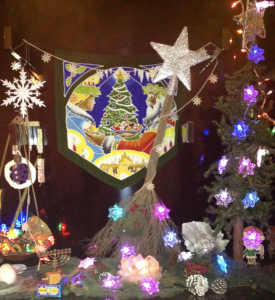
holiday altarAs both a professor and a clinical psychologist, December finds me surrounded by anxious students who fret over final papers and exams, with grades needing to be entered, and a new semester to prepare for.  Clients, cast back into family roles they’ve worked hard to transcend, often regress and need help re-stabilizing. The peaceful vacation I imagine rarely comes to fruition, while the ‘reason for the season’ is buried under social obligations and caloric intake.

This month, my clients and I will plot our way through these paradoxically stressful celebrations, while honoring the triumph of personal light over personal darkness. Like McCartney and Lennon, we acknowledge that “it’s been a long cold lonely winter”.  We trust that the lengthening days will show us how “that ice is slowly melting”, as we joyfully declare “here comes the sun”!  Another cycle of growth and harvest lays before us and the goals for spiritual growth and actualization that we named at Samhain are now articulated in greater detail.  Therapy becomes a time for thumbing through the seed-catalogs and plotting out the actual garden of our next growth cycle.

As your travels carry you past the seasonal displays of lights, I invite you to name the darkness you have traversed through and triumphed over. Name also the strengths that have served you, for they are tools that you can use again and again. As you negotiate parties, trips, family and gift giving, can you focus on the real reason for the season?  Can you feel, in your bones, heart, spirit or soul, the celebration that comes from overcoming adversity?

By reminding ourselves of what our ancestors knew – that it is always darkest before the dawn – we are able to wait with faith for the returning Light, and to give gratitude for what is illuminated.  Bright Solstice blessings to all!

Betz King, PsyDBetz King, PsyD, LP  is a fully licensed psychologist in Farmington Hills MI.  About her blog series, she writes, “The Seasonal Psychologist explores my intersectionality as a Solitary Pagan and psychologist, through an integration of teachings and tools from both psychological and spiritual traditions.”  Read more about Dr. King, including her American Priestess / Priest Training Program, here.

Posted in Uncategorized | Comments Off on The Seasonal Psychologist: On Winter Solstice

The Seasonal Psychologist: On MidSummer

The Seasonal Psychologist is a year-long series by Pagan Psychologist Betz King.  Each piece corresponds to one of the 8 Pagan Sabbats, or holidays, while exploring ways to use the symbolism of the season for personal growth and in clinical practice.

I conceptualize both my personal development, and that of my clients, within the framework of our local 4-season landscape. Mostly this means a framework of trees, crops native to Michigan, and lots of plants and flowers. The Pagan path is a seasonal one, hosting 8 holidays called Sabbats. They parallel the movement of the sun across a year. Each holiday expresses a facet of the relationship between Light, Dark, and life. I use them as lenses of reflection, opportunities to contemplate the cycle of birth, growth, harvest and death that impacts all living beings.

As a Pagan psychologist, many of my clients have some form of an earth based belief system. This allows us to revisit treatment goals seasonally. The view from my office window is lush with trees. A simple glance outside provides the framework for our review; whatever the trees are doing becomes an invitation to consider the same within ourselves.  The Oak Holly, whose strength peaks at Midwinter, begins to retreat with the warming temperatures and we are reminded that one season’s strength is another’s weakness.


Oh do not tell the priest our plight,

Or he would call it a sin;

But we have out in the woods all night,

A-conjuring summer in!

~Rudyard Kipling

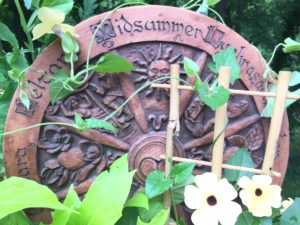
Photo of Pagan Wheel of the Year with Flowers

Wheel of the Year

Midsummer, or the Summer Solstice, marks the time of year when the sun reaches its maximum elevation.  It is the day with the greatest number of daylight hours, often called “the longest day of the year”.

Imagine that your entire existence depended on the favor of the Sun.  With it, your crops would grow strong, and after the harvest, you could store food for the winter.  With it, the days would be warm enough for your livestock to naturally mate and reproduce, thus providing you with meat, milk and skins.  With it, there would be enough warmth and daylight to travel safely to distant lands for supplies and celebrations.  Prior to our “civilized ways” we depended on the Sun, its light and warmth, for all aspects of our survival.  Hence, the day that brought us the most sunshine was truly a day of celebration, as it brought powerful opportunities for expansion and growth.

Pagan Traditions frequently consider the Mother Earth to be fully at the zenith of Her strength, sexuality and fertility during this celebration.  Crops are growing so quickly it is almost possible to seethe growth from day to day.  Buds, flowers and fruits are now visible; grain is forming on stalk and ear.  While the harvest is clearly promised, it will not take place for some time yet.  This is the midpoint of the growth cycle, and a time of both merry making and of hard work.  Summer gives Mother Earth a chance to show off a bit, and she is up for the challenge.  So many gorgeous plants, trees and shrubs show off their flowers, so many fruits and vegetables grow from seed to food in just a few short months, the life force than imbues all things is palpable and passionate. And the songs!  The glorious songs of birds and frogs and bugs, seeking mates, celebrating sunrise, singing just to sing, as if a soundtrack for all that is growing and green!

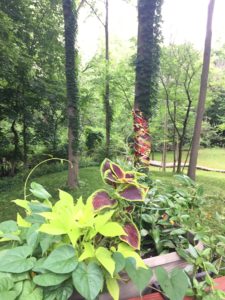
Photo of summer plants and flowers.

Plants in abundance!

Psychologically, the Summer Solstice is a time to revisit the “seeds” you may have planted last fall, or earlier this spring, and to contemplate what is now growing and expanding within yourself and your life.  It is also a time to take stock of the ‘weeds’ and ‘invasives’ that have crept into your careful plans. Just as we prune back our trees and shrubs to encourage their growth, sometimes we must make sacrifices to achieve our goals and visions. What do the expanding hours of daylight show you?

Summer is also the best time to go outside and play, to reenact perennial rituals of food, family, friends and vacations.  The extra hours of light that carry us into the evening illuminate not only lush vegetation and magical fireflies, but also the sights, smells and sounds of one’s village in full swing – cooking over fires, tending to gardens, playing games with neighboring villages, taking long walks and cool swims, hosting fairs and festivals and competitions – summertime is the easiest time to see the hidden Pagan rituals still present among us.

And even though energetically everything and everyone is going, and growing, Summer also teaches us patience as we wait for our crops to ripen, our vines to climb and our flowers to bloom.

This week, I will ask my clients what the bright light of Midsummer shows them.  We will consider their overall health, the health of their crops (physical and psychological), and the tasks to be completed before the precious daylight hours begin to shorten again. When they are pleased with what they are manifesting, we will capture the exact recipes of self-care and hard work used.  Where goals have grown wonky, or haven’t grown at all, we will problem-solve.  We still have 3 months of good growing weather, there is room for corrections and do-overs, and there is always next year.

Photo of summer plants and flowers.

Growth is everywhere.

As you enjoy the many gifts of summer, the beautiful early mornings, the bright hot sun, the enlightened evenings, I invite you to stop and pause here and there throughout your day.  Just stand still.  Look, listen, smell… this is your manifestation, planned and unplanned.  This is the zenith of your year, the brightest, the best!  Find a way to get your bare feet into some sand, water or soft green grass, and let yourself feel the fertile power of the Earth.  This is your home, and you are every bit as glorious as all that surrounds you.  Slow down and take it all in.  You are a powerful gardener, and your works of creation deserve appreciation and gratitude.

Happy Summer Solstice!

Posted in Uncategorized | Comments Off on The Seasonal Psychologist: On MidSummer